Showing posts with label e-books. Show all posts

Thursday, 29 December 2011

Big Brother

The potential for intellectual liberation through literacy came into its own with the advent of printing. Anyone could express their ideas on a previously inconceivable scale to an unlimited audience, and literacy took off. Of course the same can be achieved far more efficiently online. We've seen this happen recently with the Arab uprisings and, less impressively, with the London riots.
But the printed word can't be controlled, except through legislation, in the same way that online providers could so easily be censored at the flick of a switch. That's what bothers me. Yes, 1984 has been and gone and Orwell's dystopian warnings proved hugely misplaced. But if he were alive today, I suspect he might be issuing the same kind of dire warnings.

Is there a future for books?

Totally agree with Matt - it really doesn't matter what the medium is, as long as people keep reading. But there is another concern that e-readers raise... because the technology allows for images, 3D images, moving images, story games, sound effects... and voice overs. Will we shortly all be listening to books through headphones? Are we racing towards a post-literate society? Stories began with an oral tradition, after all.  As I wrote recently in Crime Time, I believe the story will survive. I'm not so sure about books.

A changing market place

Charlie Rice raises an important point when he mentions in one of his comments here that he is "forced to go to B&N as the smaller stores have closed." Matt talks glibly of a further 30% of sales online, but what's the tipping point? Can bookshops afford to lose another 30% of their dwindling sales?
Once the bookshops have gone, where's the market place for physical books? Buying online, is purchasing a physical book so very different to downloading an e-book - with its immediate delivery at a vastly reduced cost to the consumer? If (perhaps I should say when) the dedicated bookstores disappear, the industry producing physical books will collapse.  Will successful authors of the future be those best able to manoeuvre their way through the online jungle?  Will creativity be less important to the writer of the future than expertise in search engine optimisation?

Spot the dodo

Posted by Leigh Russell
I feel uneasily excited about the sales of my books on kindle. Last year my e-sales, small as they are, outdid the print sales of my books. Sales are gratifying in themselves, since they mean people are actually reading the books. The % authors receive on e-sales is far higher than on physical books as the publisher has no further costs once the 'book' is available online. So in money terms, royalties on the physical and e-books are not very different.  And in terms of revenue, it's far better to sell say 100,000 books @ £1 than 1,000 book at £5.  Scale that up, and the big names must be raking in millions on e-books at promotional prices.
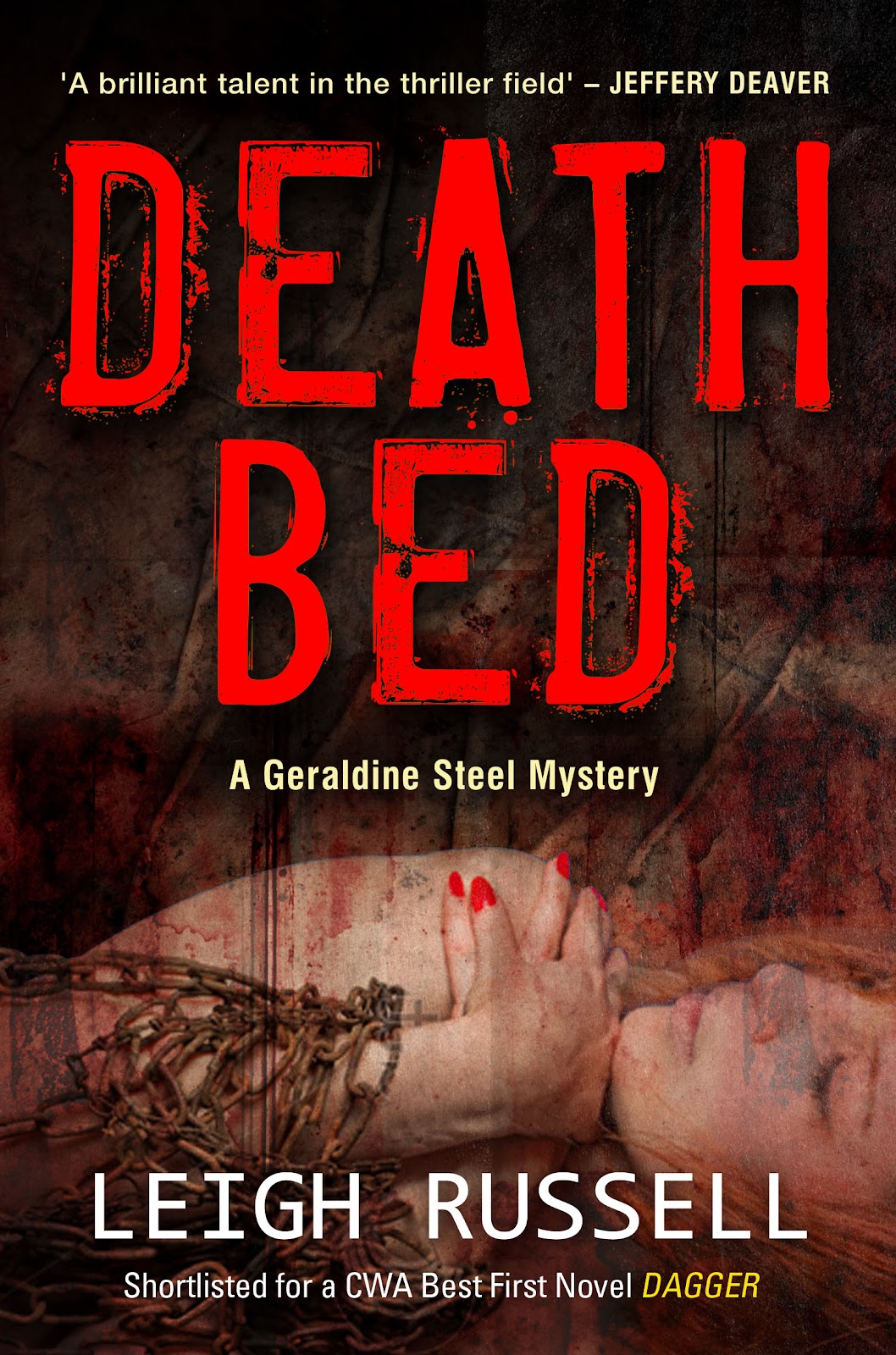
Agreed e-books open up new possibilities. Small independent publishers like mine don't have the clout or funds to get books into supermarkets, or on the telly (I know, my books were never going to reach those dizzy heights, but a girl's gotta dream...). E-books level the playing field to some extent.  Death Bed is on the 12 Days of Christmas list along with PD James and Peter James. Where else could that happen? (OK, on the shelves at Harrogate Festival, but seriously, where else?)
I take your point that many traditional publishers are set in their ways, viewing e-books as a way of promoting sales of physical books, rather than an end in themselves.  Without physical books, authors can upload books themselves.  Many do. Where does that leave publishers, unless they embrace the change? And what is their role if they do?
In my case, the complete opposite seems to be the case as my publisher is (fortunately!) more e-savvy than I am. That isn't typical. I'm the dodo here, not my publisher. Uploading and negotiating with amazon doesn't interest me. It sounds like a lot of hassle.  Amazon wouldn't offer me a better deal than my publisher gives, and my publishers are great people to work with.
The physical book has had its day and like I said, I'm feeling uneasily excited. But I'm not ready to get an e-reader yet... one day... some day... maybe...

To Kindle Or Not?

by Matt Lynn

I'm surprised that Leigh doesn't have a Kindle (see below). Leigh, you should get one right away. They are magnificently designed, and I don't think you can really understand what impact they are going to have on the book business until you have tried one out. For writers, there isn't any question that e-books are a great invention, opening up new sources of readers, and new revenue streams, and providing a forum for innovation. The interesting question, actually, is whether you want your books to be published by a traditional publisher, or whether you want to go with one of the new e-book publishers like Endeavour Press, or do it yourself. One of my worries about traditional publishers is that they sell too much on price as well as only paying a 25% royalty. 99p seems too cheap to me for a whole novel, and if you are only getting 25% of that, it isn't a great deal. Too many of the publishers see e-books as a promotional tool rather than a business in itself....and that is a big mistake.

Sunday, 6 November 2011

E-Books Are Blurring The Lines Between What Is ‘Published’ And What Isn’t:

by Matt Lynn


About the most interesting thing happening in the book trade right now is that the lines between traditional publishing and self-publishing are getting blurred. My Death Force series is published by Hodder Headline, but my Black Ops series of novellas I am bringing out myself.

More and more writers, so far as I can tell, are going down that road.

One indicator of that this week was the decision by the International Thriller Writer’s Association to allow its members to post the details of their self-published work up on their website. Until now, they had only allowed work bought by major publishers.

A hybrid model is emerging I suspect where writers do some work for major publishers, and some work for themselves, probably forming their own judgements on what mix will maximise their sales, income and creative satisfaction.

Personally I like the combination. I value the prestige of the mainstream publisher, and seeing my books in the shops. But I like the energy and immediacy of doing my own thing as well. And, I suspect I’ll soon be making more money as well.

But how exactly this is all going to work, however, no one really knows.


Saturday, 1 October 2011

A Stupid Tax on E-Books

by Matt Lynn


E-Books are the best thing that have happened to writers since…well, probably the invention of instant coffee. Sure, there is a lot of nervousness among publishers and bookshop owners and that is understandable. But for writers, they can only be good news. At the flick of a switch, you have a global market. Far more of the money generated goes to the writer. And it opens up markers for all sorts of new kinds of work.

There is one glaring injustice, however. E-books carry VAT, whereas printed books are tax-free. 

That is just short-sighted greed on the part of the Treasury. A petition has been started up on the government’s website calling for its abolition. As it rightly points out, e-books are far more environmentally-friendly than the old, paper sort. No trees get cut down. No vans drive them around the country. A book is a book, regardless of the form of delivery. It is crazy to discriminate in favour of one kind through the tax system.

I’d add another point. I bet e-books can be a huge industry for the UK. We have great writers, English is the world’s language, and we have the editors and entrepreneurs who can seize the market. And yet the Government is taxing e-books unfairly – which almost certainly means the industry won’t develop as fast as it otherwise would. Bonkers.

I’ve already signed the petition, but there are only 2,500 so far. So click on the link and add your name today.